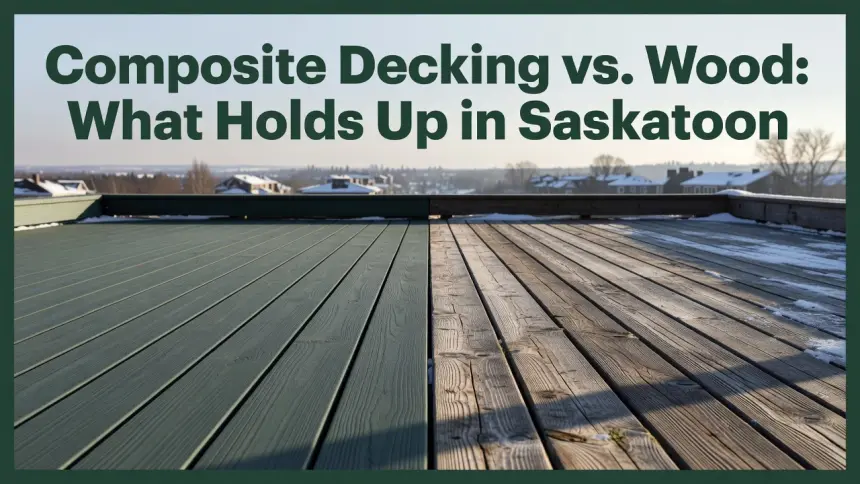
Saskatoon winters are unforgiving. With temperatures that can swing from -40°C in January to +35°C in July, your deck takes a serious beating year after year. Choosing the wrong material does not just mean extra maintenance; it can mean premature rot, warping, and costly replacement within a decade.
That is where the debate between composite decking and traditional wood becomes worth your time. Homeowners across the prairies are increasingly weighing their options, and for good reason. Each material comes with a distinct set of strengths and weaknesses, and what works well in a milder climate may struggle against Saskatchewan's extreme freeze-thaw cycles.
In this post, we break down how composite decking and wood actually perform in Saskatoon's climate, covering durability, maintenance demands, upfront costs, and long-term value. Whether you are planning a new build or replacing an aging structure, you will walk away with a clear, practical understanding of which material makes the most sense for your home and your budget. Let's get into it.
What Is Composite Decking, Exactly?
Composite deck boards are manufactured from a blend of recycled wood fibres, recycled plastics, and binding agents, extruded under heat and pressure into board profiles that replicate wood grain. The result is a consistent, dimensionally stable board that does not require the same seasonal maintenance wood demands.
Two distinct product types are on the market: capped and uncapped. Capped boards carry a protective polymer shell on three or four sides of the board. Uncapped boards leave the wood-fibre core exposed on at least the bottom and sides. That distinction matters more in Saskatoon than in most Canadian cities.
Here is why. Saskatoon sits in hardiness zone 3a. Spring and fall bring wet shoulder seasons when decking absorbs moisture before temperatures drop below zero. On an uncapped board, water enters the exposed core, freezes, expands, and degrades the board from the inside out. The cap layer blocks that cycle. It is the single most climate-relevant feature to evaluate when choosing a composite board for this region. For a closer look at how the two types compare across performance categories, this breakdown of capped vs. uncapped composite decking covers the core differences clearly.
Most boards available in 2026 are capped on three or four sides. Capped composite is also the fastest-growing segment in the category, projected at a 9.1% CAGR through 2031. That growth reflects field experience, not marketing. Contractors and homeowners working in cold climates have found that the cap holds up where uncapped products fail.
One point worth being clear about: composite is a surface material, not a structural one. The boards span between joists exactly the way wood decking does. Footings, framing, and substructure are a separate decision entirely, and in Saskatoon that decision involves frost depths and soil conditions that have nothing to do with which decking board sits on top.
Why Does Saskatoon's Climate Matter for Decking?
Saskatoon is zone 3a. The frost-free window runs from roughly late May to mid-September, which gives you about four months to actually use a deck. Ground frost can push 150 cm deep in a hard winter. That frost depth is what drives footing design; it has nothing to do with which board you put on top. Footings and decking surface are separate decisions, but both are shaped by the same climate.
The freeze-thaw cycle is where materials get tested. Temperatures swing from around -40°C in January to +35°C in July, a spread of roughly 75°C across the year. Any board that absorbs moisture during the spring thaw or a wet fall and then freezes solid in December will expand and contract repeatedly until it cracks, splits, or loses its bond. A material that sheds water rather than absorbing it survives that cycle far better. Saskatoon-specific installer experience confirms this is the primary reason capped composite outperforms wood and uncapped products on the Prairies.
Soil matters too. Saskatoon's heavy clay holds water instead of draining it. A deck built over clay in Briarwood or Stonebridge sits in a persistently wet sub-deck environment, wetter than the same deck over sandy loam in a milder city. Moisture resistance in the boards and in the substructure both matter here.
Prairie UV is intense and the air is dry. Surface coatings and stains that hold up in Vancouver or Toronto can fade and crack faster under Saskatchewan sun. Colour-through cap layers, where pigment runs through the entire protective shell rather than sitting on top as a coating, hold their appearance more reliably over a 20 to 25-year lifespan.
Add 357 mm of annual precipitation and 91 cm of snowfall, and the moisture load on any outdoor surface is constant. Cold-climate installers note that product-specific cold-climate ratings should inform purchasing decisions, not just brand reputation. Ask any contractor you speak with which products they have seen perform through five or more Saskatoon winters, not just what the manufacturer's spec sheet says.
Composite vs. Pressure-Treated Wood: How Do They Actually Compare?
Moisture absorption is where Saskatoon's freeze-thaw cycle separates the two materials fastest.
Pressure-treated pine resists biological decay, but it still absorbs water and releases it as conditions change. Each wet-dry cycle drives that moisture in and out of the board. In a climate with hard spring thaws, summer rain, and freeze-up in October, that cycling happens repeatedly every year. The result is checking, splitting, and fastener pullout, often visible within five years on an unmaintained deck. Capped composite handles this differently. The polymer shell wraps the wood-fibre core and limits direct moisture contact. Water does not penetrate the board the same way, which breaks the absorption cycle at the source.
Wood moves. Composite moves less.
As moisture content in a pressure-treated board changes, boards cup, bow, and twist. Gap spacing tightens or widens. Fastener positions shift. Over time, a deck that was gapped and fastened correctly at installation can look uneven and feel loose underfoot. Composite boards are engineered for dimensional stability. Gaps and fastener positions stay more consistent season to season, which matters when you are looking at 10 years of prairie winters.
"Low maintenance" is accurate. "Zero maintenance" is not.
Pressure-treated wood needs cleaning, sanding, and a fresh coat of stain or sealant every two to three years to stay ahead of rot and weathering. Skip a cycle and degradation accelerates. Composite eliminates that refinishing cycle entirely. What it does not eliminate is cleaning. Soap and water, or a composite-specific cleaner, once or twice a season keeps the surface performing correctly. That is a meaningful reduction in ongoing labour and material cost, but it is not nothing.
Lifespan favours composite, but the substructure is a separate question.
A well-maintained pressure-treated deck in Saskatoon typically needs full board replacement at 10 to 15 years. Quality capped composite is generally rated for 25 to 30 years. One important clarification: composite boards on a deteriorating wood subframe offer no longevity advantage. The joists, beams, and footings need to be built correctly and independently evaluated. In most cases, the substructure outlasts the decking surface regardless of material choice.
Appearance holds better on composite under prairie sun.
Wood can be refinished and restained, and it carries a traditional look many homeowners prefer. Composite holds colour more consistently. UV-stable cap layers resist fading better than stained wood under high-UV prairie summers. Scratches on composite are visible but do not compromise the board structurally. One comfort note worth knowing: composite retains more heat underfoot than wood in direct afternoon sun, which can be a factor on a south-facing deck in July.
Wood remains the dominant decking material across North America by volume, but composite is taking measurable share in the residential renovation segment, not new builds. Homeowners replacing a deck that has reached end of life are the primary driver of composite adoption, which makes sense given the lifecycle cost argument. The higher upfront material cost becomes easier to justify when the alternative is rebuilding in 10 years.
Is Composite Worth the Higher Upfront Cost?
Composite boards run roughly 2 to 3 times the material cost of pressure-treated lumber, depending on board profile, cap type, and supplier. All composite pricing in CAD moves with the exchange rate because most product is manufactured in the U.S. Any figure published today may not match what your supplier quotes next month. Get current numbers from an actual supplier, not a blog post.
The more useful comparison is total cost over 20 years. A wood deck in Saskatoon needs staining or sealing every 2 to 3 years. That means labour and materials on a recurring cycle, not a one-time expense. By year 12 to 15, a pressure-treated deck in this climate is likely facing partial or full board replacement from the cumulative effect of freeze-thaw cycling and UV exposure. One published estimate puts the composite material premium at around $8/sq ft upfront, offset by $15 to $20/sq ft in avoided refinishing costs over 20 years. The math shifts significantly when you stop comparing purchase price and start comparing project cost across the life of the deck.
Labour works the same way. Composite installation using hidden fastener systems takes longer per square metre than face-screwing wood. That added time costs more upfront. It is paid once. Refinishing a wood deck every few years is either contractor labour at current Saskatoon rates or your own time. The asymmetry matters: composite labour is a one-time line item, wood refinishing is a subscription.
One cost that does not belong in the composite premium column is the substructure. Joists, beams, and footings are built to the same spec regardless of what goes on top. Footing depth in Saskatoon is set by frost depth, not surface material. Composite does not require a heavier or more expensive frame.
Site conditions and earthwork move total project cost more than the choice of decking material. Clay soils, lot grade, and drainage all affect what goes into the ground. A flat number from any source is a rough guide at best. The only reliable figure is one based on your specific site. On-site quotes are free; call (639) 638-8899 to set one up.
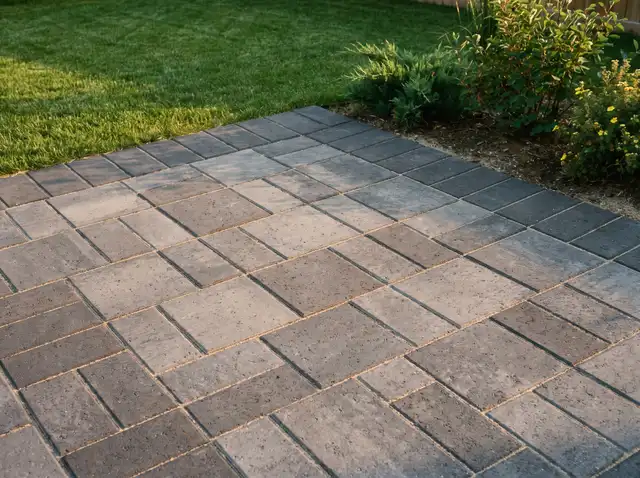
The same logic governs anything built at grade beside the deck. A patio or a walkway costs what the ground under it costs, which is why New Jersey crews doing hardscape and pavers quote excavation, base depth and drainage as separate lines instead of folding them into a square-foot price. On Saskatoon clay the buried work is the larger share, and it is the first thing a cheap quote trims. If a deck and a patio are going in the same season, have both priced on one site visit — the excavation overlaps, and so does the machine time.
What Goes Under the Deck Matters More Than the Surface
The best composite board on the market will not save a deck built on footings that move. In Saskatoon, that is the real risk. Choose your surface material carefully, but get the substructure right first.
Footings: Depth Is Not Negotiable
Footings for a permanent structure must reach below the frost line. In Saskatoon, that means a minimum of 180 cm. Heavy clay soil, common across neighbourhoods like Arbor Creek, Stonebridge, and out into the RM of Corman Park, can hold moisture and amplify frost movement. Site conditions sometimes push required depth beyond that 180 cm minimum. If your contractor cannot tell you exactly how deep your footings will be placed before the job starts, that is a problem.
Screw Piles vs. Concrete Piers
Screw piles are a practical footing solution in this market for one straightforward reason: they go in year-round, require no excavation in clay, and reach bearing depth without a cure window. A helical screw pile is threaded to depth by a torque drive and capped with a steel bracket that ties directly into the beam. The whole process takes hours, not days.
Concrete piers are a workable alternative, but timing matters. Concrete must not be poured at or below 0°C without cold-weather precautions, and framing cannot start until the pour has cured. In a four-month build season, that timing constraint is real.
Framing and Utility Locates
Frame with pressure-treated lumber regardless of what surface boards you choose. Composite framing products exist but are not yet common on Saskatoon job sites. Treated 38x140 or 38x184 lumber is standard for joists, with sizing driven by span.
Before any footing goes in, utility locates must be arranged. This applies to screw pile installation just as it does to any other digging. Saskatchewan One Call exists for this reason. A responsible contractor books locates before the first pile turns.
For more detail on how we build footings and frame decks for Saskatoon conditions, see our deck building page.
What Does Low Maintenance Actually Mean on the Prairies?
"Low maintenance" is accurate. It is not the same as no maintenance, and the prairie environment makes that distinction concrete.
Prairie winds pick up fine grit and push it into the grooved surface profiles and fastener gaps of composite boards. That debris does not just look untidy. When it holds moisture, it holds moisture against the substructure framing below, which is typically still pressure-treated wood. The board surface stays dry; the joist does not. Sweep and rinse the deck in spring after snowmelt clears, and again in fall before the ground freezes. Those two cleanings a year protect the framing as much as the boards.
Mould and mildew are a real issue on shaded sections of composite decks during the damp weeks of May and early June. Snowmelt keeps the surface wet for longer than rain does, and shaded north-facing areas stay cool enough to support growth well into the season. Clean it with a composite-specific cleaner. Do not use bleach on capped boards; bleach degrades the polymer cap layer, which is the part of the board doing most of the moisture and stain work.
Snow removal: use a plastic-blade shovel or a rubber-edged pusher. Metal blades scratch composite surfaces. The scratches do not affect structural performance, but on solid-colour boards they are visible and permanent. Most homeowners in Sutherland or Evergreen already keep a metal shovel by the front door for sidewalks; keep a separate plastic one for the deck.
UV fading on composite is slower than on stained wood but it is not zero. Premium capped boards use mineral pigments in the cap layer that hold colour better under sustained UV exposure in prairie climates. Saskatoon gets strong sun on south-facing exposures from March through September. After 5 to 7 years, expect some lightening, particularly with dark colour selections like charcoal or espresso tones. Lighter mid-tone boards show less visible shift over time. Check the fade warranty on the specific product before you choose a colour; the coverage period and acceptable variance differ between product lines.
When Can a Composite Deck Be Built in Saskatoon?
Saskatoon's effective build season runs from late May through mid-September, roughly 16 weeks. Concrete footing pours require unfrozen, workable ground. Framing and decking in temperatures below about 5°C slows work, increases the risk of installation errors, and complicates adhesive and fastener performance.
Screw pile installation extends the shoulder season in both directions. Because screw piles are driven rather than poured, they do not require open excavation or curing time. Bearing capacity depends on soil density and pile depth, not air temperature alone. That means a pile crew can often work into late October or start in early May, conditions where concrete work would be impractical. The framing and decking still needs to wait for warmer air, but getting piles in early frees up schedule in the main window.
Composite boards should be installed above 10°C. Below that threshold, boards are stiffer and less forgiving during fastening. More importantly, gap spacing between boards must account for the full temperature differential between the day of installation and peak summer surface temperature, which on a south-facing Saskatoon deck can exceed 60°C. A board installed at 5°C will expand significantly more than one installed at 20°C. The gap adjustments required for cold-weather composite installation are product-specific; an experienced installer works from the manufacturer's gap table, not a general rule.
Plan and quote by March or April if you want a deck ready for the July long weekend. Build timelines run two to six weeks depending on size and complexity. Permits add lead time on top of that.
Speaking of permits: the City of Saskatoon requires a building permit for decks higher than 200 mm above grade or over 2.32 square metres at 600 mm or more of height. A contractor who builds regularly in Saskatoon knows which configurations trigger an application and what inspections are required. Ask that question directly before signing anything. Call (639) 638-8899 to discuss timing and scope.
So Who Should Actually Choose Composite in Saskatoon?
Composite is the right call if you plan to stay in the property for 10 or more years and you are tired of refinishing. Wood decks need sanding and recoating every two to three years. Over a decade, that is three or four refinish cycles, each with real labour and material cost. Composite vs. wood decking compared for Saskatchewan conditions confirms the higher upfront cost of composite, but the maintenance gap closes quickly when you stop paying for stain and a weekend of work every two seasons.
Composite is also the right surface for shaded or low-ventilation positions: a north-facing deck, a deck under tree canopy, or a tight side-yard run where airflow is limited. Wood in those spots stays wet longer after snowmelt and spring rain. Composite does not rot. That single property changes the calculus for any deck that cannot dry out quickly.
If budget is tight and the ownership horizon is five years or fewer, pressure-treated wood on a correctly built substructure is still a legitimate option. The substructure performs identically under either surface material. Getting the footings, framing, and joist spacing right is the non-negotiable part.
Homeowners in Warman, Martensville, Langham, and on acreages in the RM of Corman Park face the same heavy clay soils and frost depths as Saskatoon proper. The material decision is the same across the entire service area.
Before any surface material discussion, ask your contractor one question: what footing depth are you building to, and why? A vague answer is a problem. 78% of wood deck owners report regretting their choice, but a composite board on a poorly built substructure will still heave. Get the substructure answer first. For a site-specific assessment, call (639) 638-8899.
The Short Version Before You Call
Capped composite does not absorb water. That is the core advantage in Saskatoon's climate, where freeze-thaw cycles work through wood boards from the inside out. Everything else, colour retention, splinter-free surface, low annual upkeep, follows from that single property.
The substructure is not negotiable. Footings need to sit below frost depth, joist sizing needs to match the span, and a utility locate through Saskatchewan One-Call needs to happen before any digging starts. These requirements apply regardless of whether the surface is composite or pressure-treated lumber.
Price the project over 20 years, not at the lumberyard. Composite costs more upfront. Wood costs more over time in labour, stain, and board replacement. Ask any contractor quoting the job to put the footing depths and joist specification in writing before a shovel goes in.
The build season runs roughly 16 weeks. If you want a deck built this summer, the conversation starts now.
Landscaping Saskatoon Pros builds decks in Saskatoon, Warman, Martensville, and the surrounding communities. On-site quotes are free. Call (639) 638-8899, Monday to Saturday, 7 am to 7 pm.
Conclusion
Saskatoon's climate is demanding, and your decking material needs to match that reality. Here is what it comes down to: composite decking offers superior resistance to freeze-thaw cycles, minimal maintenance, and stronger long-term value. Traditional wood costs less upfront but requires consistent care and carries a higher risk of warping, rot, and early replacement in prairie conditions.
Both materials can work, but the right choice depends on your budget, lifestyle, and how much ongoing maintenance you are willing to commit to.
You now have the information to make a confident, informed decision. If you are ready to move forward with your deck project in Saskatoon, reach out to a local contractor who understands prairie-specific building challenges. The right deck, built with the right material, will give you decades of reliable outdoor living.
Frequently Asked Questions
Want someone to look at your yard?
Tell us what you need and where the property is. We come out, look at the ground, and give you a written scope and price — no charge and no obligation.
- Free on-site quotes across Saskatoon
- Prairie-hardy plantings that survive zone 3a winters
- Utility locates arranged before any digging
- Summer yard work and winter snow from one contractor
- Written scope before a shovel goes in the ground